
By
Pablo Rivera-Vargas, Carles Lindín and Mercedes Blanco (UB Team)
🇪🇸 Versión en español: leer aquí
Investigating the impact of artificial intelligence in education raises a less visible challenge: how can we analyse ethical practices and dilemmas that those experiencing them are not always able to identify or articulate?
In many cases, students and teachers use digital technologies on a daily basis, but without clear frameworks to understand their implications. This limits not only educational practice itself, but also our ability to study it critically.
In this context, the Awareness Raising Sessions (ARS) we have developed throughout the project become a key tool: they introduce a process of prior sensitisation that enables teachers and students to recognise, name and reflect on practices and dilemmas that would otherwise go unnoticed.
Beyond perceptions: a shared structural tension
In the case of the sessions carried out at the Universitat de Barcelona within the framework of the ETH-TECH project, the experiences gathered from both teachers and students go beyond individual perceptions and reveal a structural tension that runs across the entire educational system.
Teachers show a clear awareness of the importance of ethics in AI, yet they face difficulties in integrating it into practice. This limitation is not merely individual; it is shaped by structural conditions such as dependence on digital platforms, lack of transparency in the systems used, and limited access to specific training.

Students, for their part, engage with these technologies on a daily basis, but without clear interpretative frameworks. They use AI tools in academic contexts marked by ambiguity: uncertain about what is allowed, how systems work, or what implications their use entails.
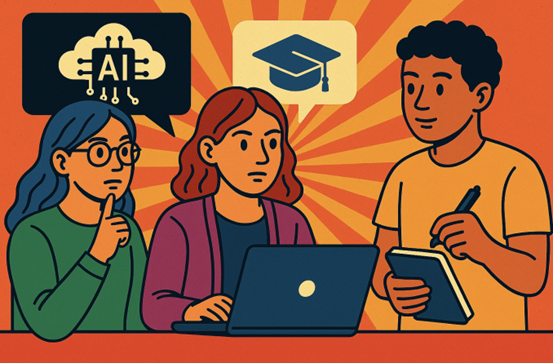
What matters here is not only what each group does, but what they share: an educational practice increasingly mediated by technologies that are not fully understood.
The paradox: critiquing systems we depend on
One of the most significant findings emerging from these experiences is a difficult-to-avoid paradox.
On the one hand, there is a growing critical awareness of the effects of digitalisation and artificial intelligence: algorithmic opacity, data extraction, dependence on corporate infrastructures, and inequalities in access. On the other hand, both teachers and students—and also those of us researching these processes—depend on these same technologies to teach, learn and produce knowledge.
This raises a dilemma that is not individual, but structural: how can we develop a critical practice when it is sustained by systems that reproduce the very dynamics we seek to question?
The value of ARS: when research requires prior understanding
In this context, the Awareness Raising Sessions offer a key differentiating element.
In educational research, we often face an under-recognised problem: the people we study do not always have the conceptual frameworks needed to critically interpret their own practices.
Without this foundation, many experiences remain naturalised, fragmented, or difficult to problematise.
ARS respond directly to this challenge. By introducing an initial process of sensitisation—ethical frameworks, key concepts and concrete dilemmas—they enable a more conscious, articulated and critical form of reflection.
For this reason, ARS are not only a training space, but also a methodological device: they make it possible to investigate complex phenomena through situated and shared understanding.
From awareness to action
The sessions clearly reveal a gap:
- There is awareness of the ethical challenges of AI, but real difficulties in translating this awareness into educational practice.
- Teachers identify limitations in integrating principles such as transparency or accountability into their courses.
- Students, in turn, call for clearer guidance, specific training, and spaces for discussion in order to act in an informed way.
At the same time, additional dimensions emerge that expand the debate: the emotional impact of technology, the feeling of being monitored, and its social and environmental consequences.
Rethinking teacher education in the digital age
These findings point to a clear need: ethics cannot be treated as an additional topic, but must become a transversal dimension of teacher education.
This implies moving beyond the instrumental use of technology and towards a form of training that enables future teachers to:
- understand technological logics,
- critically question their implications,
- and make informed pedagogical decisions.
In a context of increasing digitalisation, preparing critical teachers is not just an option, but a condition for a more just and conscious education.
What now?
Artificial intelligence is already here. The question is not whether to use it, but how to position ourselves in relation to it.
Perhaps the most important question is:
Do we want teachers who use technology… or teachers who are able to understand it, question it and make decisions about it?
What do you think? What role should AI ethics play in teacher education?
Leave a Reply