
Inhabiting Technological Present and Futures: What’s my postdigital Positionality?
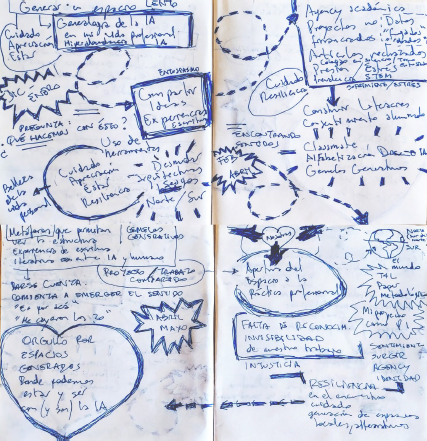
“It was the autumn of 2023, when I started a conversation with Mariana Ferrarelli (Argentina) and Nohemi Lugo (México) about how overwhelming AI was for us, as people working from decades in educational technology. Inspired by Sarah Hayes, I proposed to them a journey: exploring our postdigital positionalities as they evolved along and across the several contexts we were facing. Our stance hence was troubled by several critical incidents, several daily insights and moments of puzzlement. We suspended our judgement and hence, we really understood that slowness was the only way of inhabiting the margins of the mainstream, the way of responding to the acceleration of generative AI. We hence took the time to practice care, and hence to build a relational scholarship, dwelling with uncertainty. We did not reject technology. No. We inhabited it in a different way. The whole story is told here.” (Juliana E. Raffaghelli)
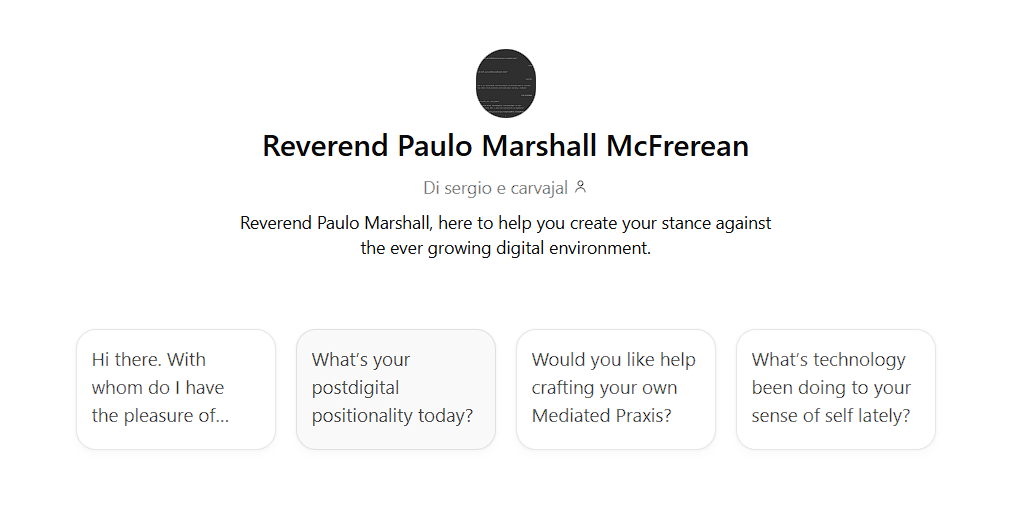
“When I began reflecting on my own postdigital positionality, I realized that the answer could not be purely theoretical. As a professional media maker who has lived through the transition from analogue to digital (from tapes, to CDs, to MP3s, to streaming, and now to AI-generated music) understanding technology for me had to involve both reflection and action. This is how Reverend Paulo Marshall McFrerean came to life: a custom conversational agent I built through purposeful and careful experimentation, using curated ideas from Paulo Freire and Marshall McLuhan. The Reverend represents a stance that I describe as mediated praxis. Mediated praxis is the idea that in order to navigate this technological world, one must practice: create, reflect, create again, and repeat that cycle endlessly. Through this ongoing process of making and reflecting, we begin to understand (and counteract) the many ways our lives and thoughts are shaped by digital mediation. My journey toward developing this positionality is also part of the short video presented alongside this art contest.” (Sergio Carvajal-Leoni)
These two narratives are generative in what they set in motion: conversations, relationships, articles, even chatbots. Here, we open an art contest as a space to inspire and express your postdigital positionality.
Whether your stance is slowness, faster tech, refusal, repair, or another future altogether, we invite you to imagine the technological life you want to inhabit…through art.
Launching the Art Contest
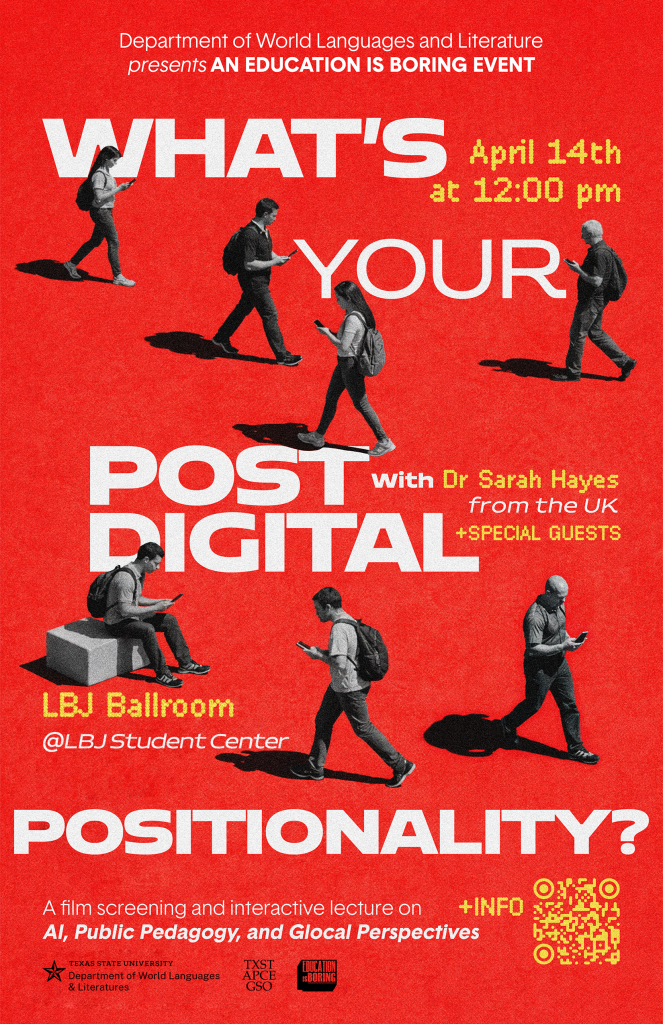
Join the launch of the ETH-TECH Art Contest and share your vision of possible futures.
📅 Tuesday, April 14th, 12:00 PM – 📍Texas State University – LBJ Ballroom, LBJ Student Center
Objective of the Contest
The aim of this contest is to develop an art work that is an original representation of a personal exploration: your unique approach to express or to question “What is my postdigital positionality”?
Before you start
Before diving in, take a look at this guide on the creative process to help you find your approach:
🚀 https://eth-tech.eu/exploring-the-post-digital-world-through-creative-reflection/
In particular, watch the video on postdigital positionality: you will get to understand the concept of postdigital positionality, meet the characters that introduce the contest, and learn what a “reflection package” is.
Contest Details
Who can participate?
The call is open to university students across the globe who are enrolled in creative, artistic, design, media, psychology, or education disciplines. Eligible participants include Bachelor’s, Master’s, and PhD students, as well as graduates (alumni).
Submissions can be made individually or collectively, with teams of up to 3 participants.
Which are the submission requirements?
Each participant is invited to create one original work. That means, each participating student/team creates a submission. Each submission should include:
- The title of the proposal.
- A brief narrative (250-500 words) that introduces the concept of postdigital positionality the work embraces or represents.
- A description of the creative process (250-500 words):
- If AI tools (e.g., Midjourney, DALL·E) are used, explain how they were integrated and provide the prompts used.
- If the work is entirely handcrafted, describe the materials and ideas that informed the creation.
- A digital copy of the artwork.
Submission Guidelines
Which is the type of format you should use?
- A virtual copy (or the digital work) should be submitted in one of the following formats: TIFF, JPEG, PNG (minimum 1080 × 1080 pixels), GIF, or MP4 (1920 × 1080 or 1080 × 1920). Videos must not exceed 3 minutes in length.
- Contest winners may later be asked to provide a higher-resolution version of their work for showcase purposes.
- Submissions must be provided via a link to a storage service (e.g. Google Drive, OneDrive, WeTransfer).
- All texts (descriptions and reflections) should be submitted through the online form
And what about the deadline?
Submissions must be sent by 07/07/2026 at 1:00 p.m. (CEST) via this form: https://forms.gle/5fwyb6uJqBKPQ9D69
[Submissions will be accepted until the maximum number of 100 entries is reached.]
How should you prepare your work?
You will find all instructions within the form, which also includes an informed consent question and the approach to anonymise your work.
Awards and Recognition
What recognition and opportunities will winners receive?
The winning projects will be featured on the ETH-TECH website (as permanent exposition) and social media channels.
Winners will receive a certificate of recognition, and their work may be showcased in exhibitions and workshops across ETH-TECH European universities part of the consortium. Also, a Seminar will be organized to make a public presentation of the work, via an online seminar organized in September-October 2026.
Moreover, Education is Boring will offer:
- $500 for the First Prize
- $300 for the Second Prize
- $200 for the Third Prize
In the case of group submissions (maximum 3 people), the prize will be divided equally among the participants. The team may also choose to present their work under a collective identity.
What are the evaluation criteria?
- Originality and creativity in visual representation.
- Clarity and depth of the accompanying explanation.
- Thoughtfulness in the description of the creative process, including the integration of AI tools if applicable.