
By
HSU Team (Sigrid Hartong & Ina Sander)
🇩🇪 Deutsche Version: hier lesen
In October 2025, the team from the University of Padua passed the baton of leading the current work package (OER development) to the team of the Helmut-Schmidt-University in Hamburg. Of course, we had already started making plans for work package 3 beforehand, but now was finally the time to get started! The main goal of our work package is to develop drafts for open educational resources (OER) that build on the previous results of work package 2 – including the Framework for Practice and the Self-Reflection Tools – and that foster reflection on how the ethical guidelines on the use of artificial intelligence and data in teaching and learning for educators by the EU could be implemented in practice. Together with all partners of the ETH-TECH project, we decided – based on the results of the awareness raising sessions – to focus on three of these guidelines: human agency and oversight, transparency, and diversity, non-discrimination and fairness. For each EU principle, one OER is developed that offers educators support in gaining deeper knowledge on the respective principle through applying a co-design method with their students, and to navigate decision-making.
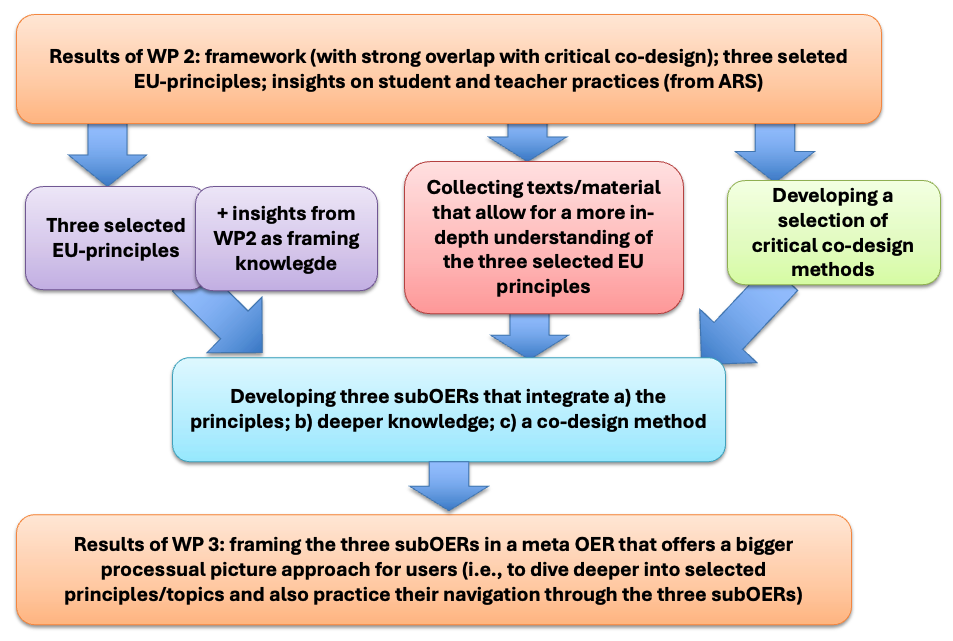
To develop OER that are truly useful for educators as well as students, we created a complex workflow that closely involves university students into the OER development and incorporates several rounds of feedback and revision. This workflow builds on previous discussions and preparatory work of all ETH-TECH partners. In the partners’ meeting in Cluj in summer 2025, all partners not only selected the three EU principles for the OER, but also collected material to help the students get familiar with these principles, selected example OER to inspire the students’ own designs, and discussed the co-design methods that would be implemented in the OER, This blog story focusses on how the second step that builds on this preparatory work: The embedding of the OER development into a M.A. seminar at HSU.
From October to December 2025, Ina Sander led a seminar on “sociological technology studies” as part of the M.A. course Education Science at the Helmut-Schmidt-University. In the first weeks, the students learned about the datafication of society and the education sector, discussed ethical perspectives on these developments and tried out existing open educational resources that foster critical reflection on data technologies. The seminar then explored the EU guidelines in more detail, and the students were grouped along the three selected principles: human agency and oversight, transparency, and diversity, non-discrimination and fairness. After this, the students dived into academic literature as well as journalistic reports on ‘their’ principle to deepen their knowledge of the field. The materials used for this were informed by recommendations from all ETH-TECH partners.
In week 4, we started into the OER development. As a first step, the students developed scenarios in the form of creative short stories that describe the current state of technology usage in education regarding their EU principle, for example describing how opaque the data processing and result creation of large language models is. Through a speculative futuring method, they then developed ideal scenarios for each principle: How would a future use of technology that perfectly implement this EU principle look like for you? This future scenario constituted the goal of the OER: this future is what the OER wants to work towards.
The students further learned about different co-design methods, which were previously discussed with all ETH-TECH partners. Our idea behind developing OER that implement co-design methods was to animate future users of the OER to think critically and test and explore, rather than aiming for easy and straightforward answers; to examine their own educational setting more closely; to give space for emotions; and to consider various perspectives, including under-represented voices and conflicts. This, we believe, is best achieved by not providing learners with the ‘right’ answers on what an ethical technology use in education looks like, but to let them explore these questions on their own. More specifically, we introduced the students to the methods of conflict mapping, storyboarding for empathy, photovoicing, cultural probing, actstorming, as well as empathetic contract creation. Each group was encouraged to select one method that, in their view, works best for fostering reflection on their EU principle.
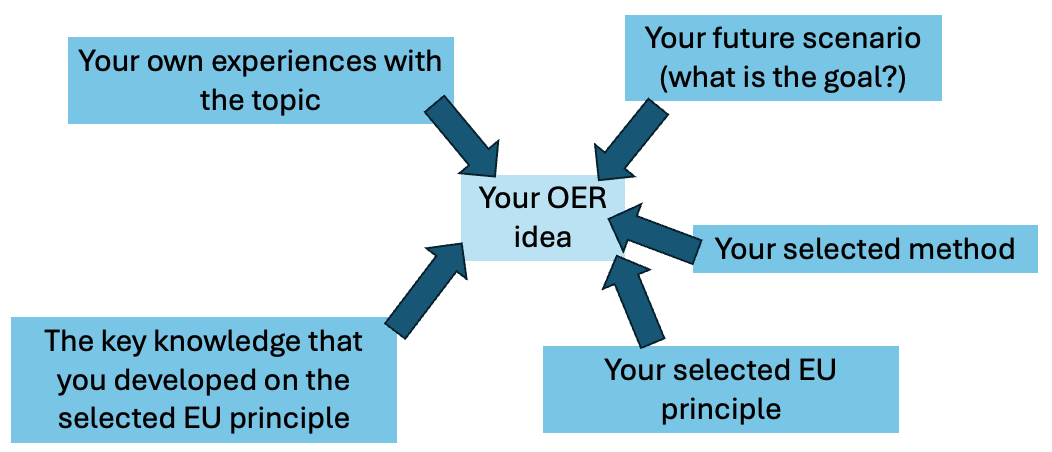
Based on their knowledge on the EU principle, their future scenarios, their own experiences with technology use in education, and their selected co-design method, the students then started into developing their first ideas for their OER. With this, a multi-stage testing and feedback process began (see visualization).
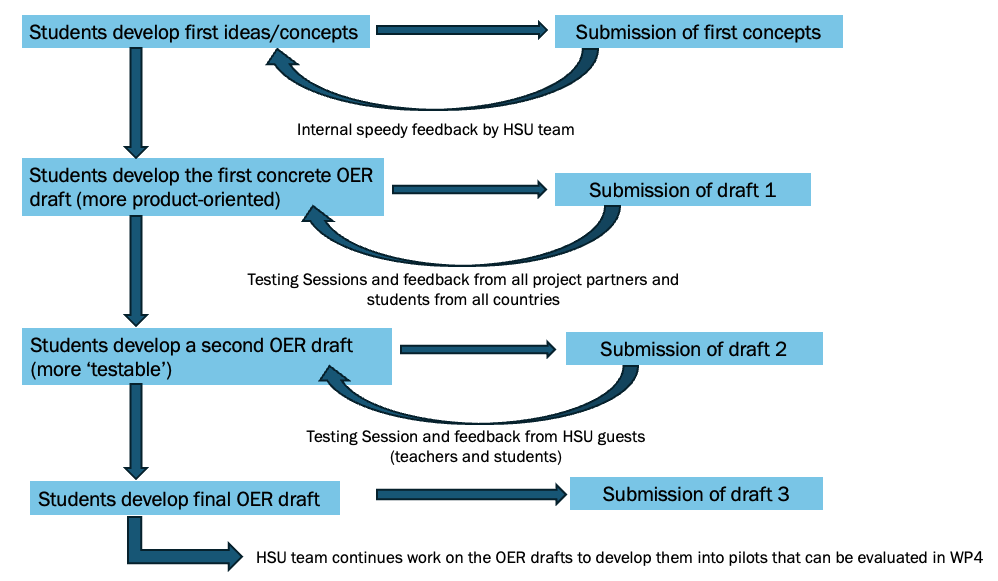
As a first step, the initial OER ideas were discussed and feedback provided by the HSU team (Ina Sander and Sigrid Hartong). After another week of development, the students recorded short pitches, in which they showed and described their OER drafts. These pitches were used for asynchronous and synchronous national testing sessions with all ETH-TECH partners as well as further students and university teachers in Italy, Spain and Romania. This proved a very valuable step, as the international students and teachers provided detailed feedback and an important ‘outsider’s perspective’ on how easily understandable and useable the OER drafts were as well as how to make them more attractive for their target audiences. Based on all of this feedback, the students continued to work on and revise their OER drafts into a more refined and ‘testable’ version. This version was tried out in another testing session with teachers and students from Helmut-Schmidt-University. The seminar students then undertook a final revision of their OER drafts, which they submitted in mid-December, at the end of the seminar.
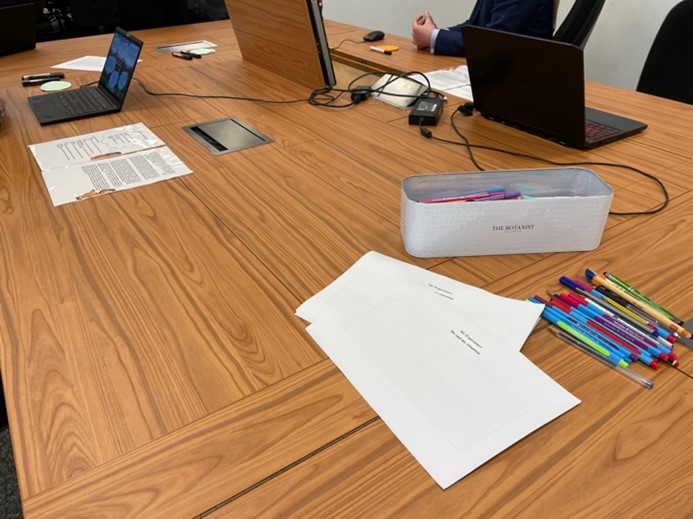
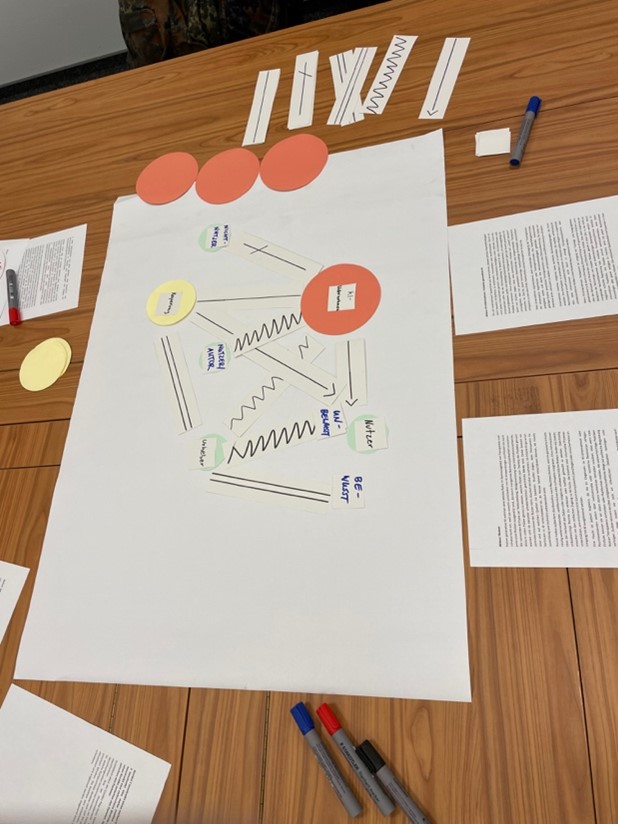
With this last submission, we reached the end of a complex, but also highly engaging and participatory seminar. We are extremely happy with the results of the student group work and very much look forward to continuing our work on these OER drafts together will all ETH-TECH partners over the next weeks. This will include a designated design workshop in January 2026 as well as another international testing session that is open to the public – please join us! The goal of work package 3 is to develop OER pilots, which can then be used in work package 4. In some cases, this further development will even include the seminar students, some of which are eager to continue contributing to the OER development in their free time, outside of the seminar context. Thus, although it is much more preparation work than a ‘standard’ seminar, we highly recommend such participatory approaches to university seminars and to OER development processes!
Leave a Reply